
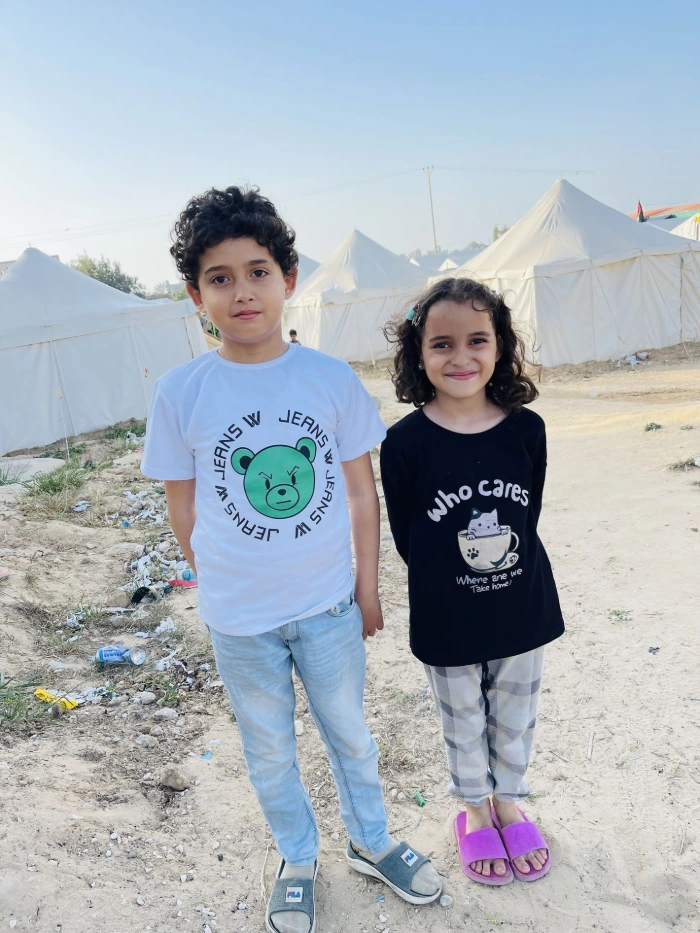
Farah and Sara grew up knowing that life could be taken away at any moment, but also believing — because their parents insisted on this — that life should still be lived with care, study, and dignity.
When the war intensified, childhood was abruptly interrupted. Days were measured by explosions, nights by the fear that morning might not come. They learned early how to listen for danger, how to read silence, how to process grief without funerals. Cousins, friends, neighbors: names became absences.
Then Amna was hit.
The news came like a fracture in time. Their sister was alive, but forever changed. Relief and terror occupied the same space. From that moment on, Farah became older than her years. At nineteen, she took on a role she had never asked for: protector, once again, translator of pain.
Sara, still a minor, experienced the war differently. Her body held her back silently — through anxiety, insomnia, a vigilance that never fully relaxed. She learned to make herself small, to not ask for too much, to survive without disturbing.
When the possibility of evacuation arose, it did not seem like salvation. It felt like separation. Leaving meant safety, but also guilt. It meant distancing themselves from parents who told them, with a strength that still hurts to remember, that children must go first.
They arrived in Europe thin, exhausted, and uprooted from everything that was familiar. Safety did not erase the war. It simply moved it inside.
In Carloforte, Farah and Sara have started over, slowly. They shared a small apartment and a tacit pact: no matter what happens, we stay together. Farah has learned to take on responsibility without turning it into hardness. Sara has gradually learned to breathe without fear.
They attended medical appointments, therapy sessions, schools. They adopted two kittens — not as a symbol, but because caring for something fragile felt necessary. The community around them did not erase their trauma, but refused to leave them alone with it.
Farah remains young, despite all that she has had to endure. Sara remains fragile, despite all that she has survived. Their strength is not loud. It lives in everyday gestures: walking together, studying, laughing unexpectedly, surviving ordinary days.
Their greatest wound is not what they have lost. It is who they are still separated from.
Their parents remain far away. The family is divided by borders, permits, waiting lists. Yet, Farah and Sara carry their parents within them — in their values, in their restraint, in their refusal to let bitterness define them.
Their story is not about escape. It is about resilience. About growing up without safety nets. About remaining human in conditions that seek to erase humanity.
They did not choose this life. But they choose, every day, how to live it.