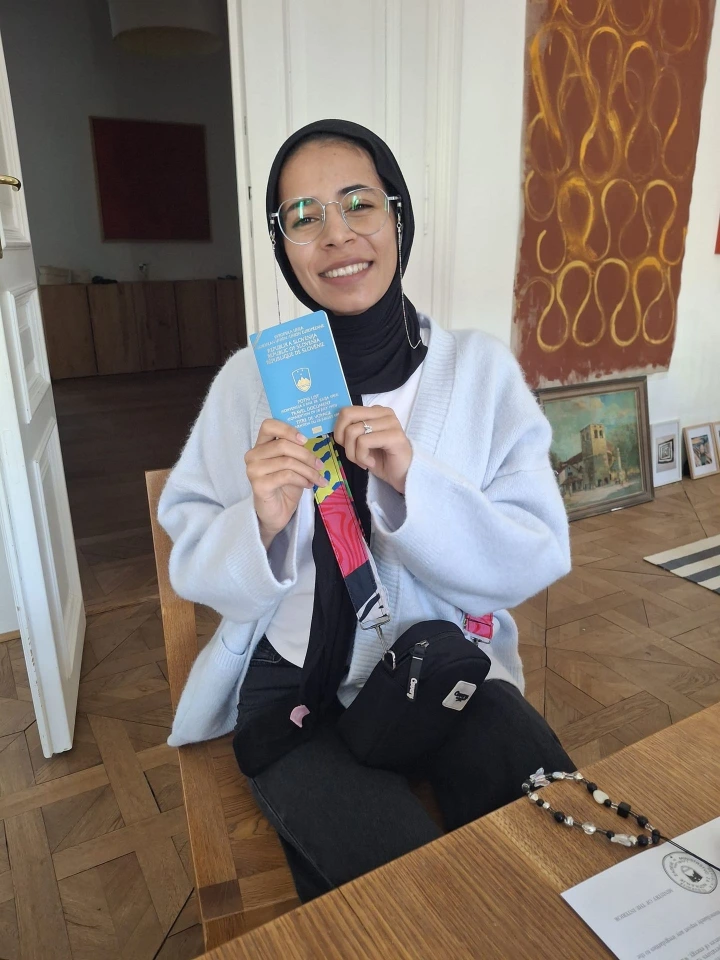
Amna was twenty-one years old when a missile hit her.
It was not a battlefield. It was not a front line. It was an ordinary moment in a life already constrained by war. The missile did not ask who she was, what she loved, or what she was dreaming of. It simply decided what it would take.
It took her leg.
It took two of her fingers.
It left burns on her body that still speak, when the skin remembers.
Amna survived.
Survival, however, is not a clean word. It does not come with clarity or relief. It comes heavy, laden with guilt, pain, and unanswered questions. Why her? Why not the others? Why now?
When Amna reached Europe, she carried with her more than just simple wounds. She carried her family within her. Her parents, still trapped. Her younger sisters, Sara and Farah, still in Gaza. Their fear screamed louder than her own pain.
She did not ask first for herself. She asked for them.
She learned to walk again on a prosthetic while thinking of the sisters she could not protect. She learned the hallways of hospitals, medical terms, and the patience of rehabilitation while negotiating evacuation lists, documents, permits. Her body was being rebuilt while her heart remained in Gaza.
Amna does not often talk about the moment of the explosion. Instead, she talks about responsibility. About how being the first to leave meant becoming a bridge for others. About how surviving created an obligation: to take up space, to insist, to not give up.
In the end, her sisters followed her. Not because the world had become safer, but because persistence can sometimes open cracks in walls that seem immovable. Amna saw them arrive thinner, older than their age, burdened with a pain that no suitcase could contain.
She did not become strong because she wanted to. She became strong because there was no alternative.
Today, Amna lives with a body that will never return to what it was before. But her presence fills the rooms with a silent authority. She knows the price of fragility. She knows what dignity requires. She knows that independence is not the absence of help, but the right to receive it without humiliation.
Amna's story is not about heroism. It is about continuity. About the refusal to disappear. About the insistence that a life interrupted by violence still deserves education, care, love, and a future.
Today she walks differently.
But she walks forward.
And she never walks alone.